Why Real AI Workflows Need Human Approval, and Why Most Tools Get This Wrong
Autonomous agents are demo-perfect and production-fragile. Here is why human-in-the-loop is the difference between an AI workflow that runs and one that gets trusted.
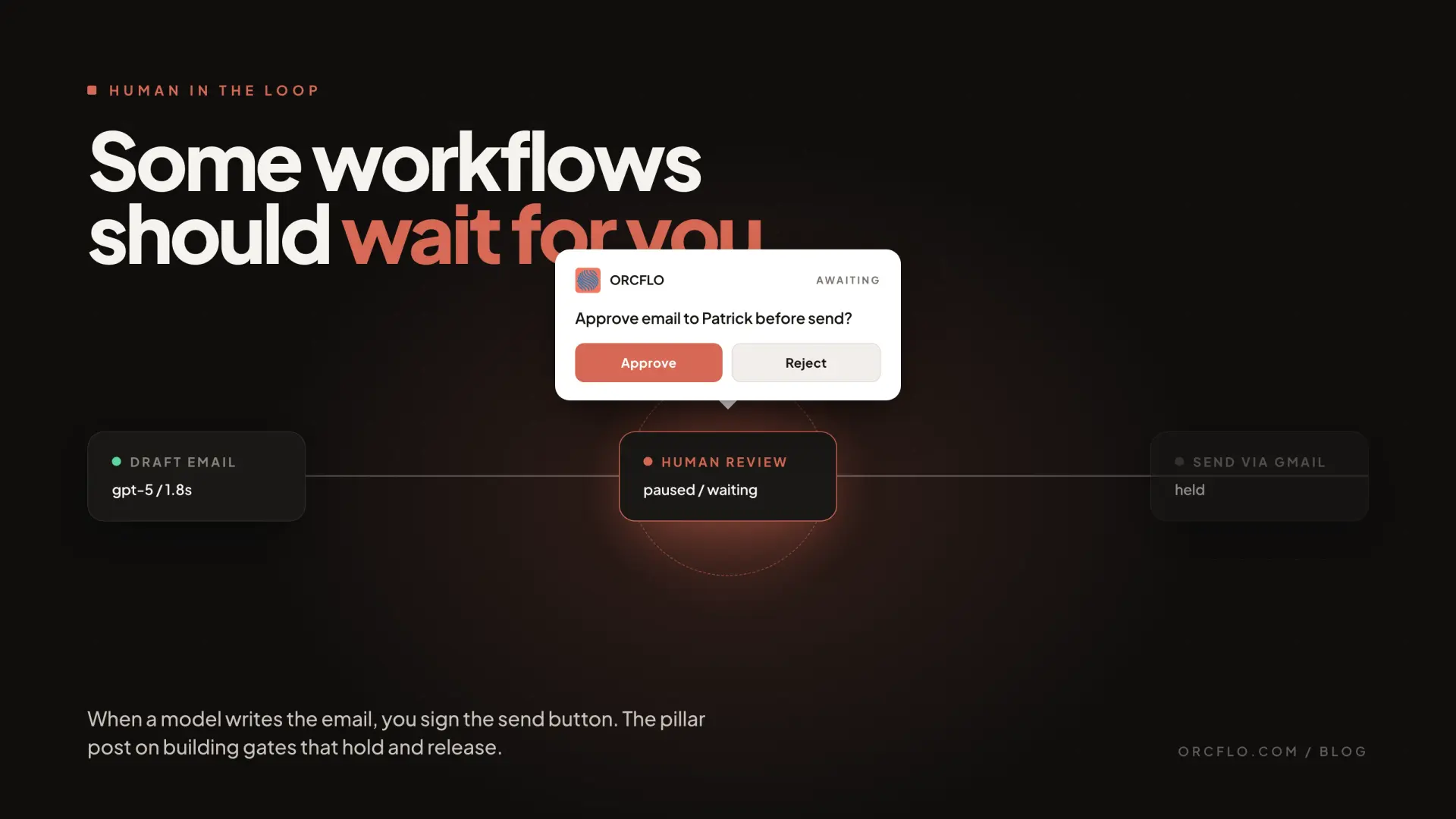
Autonomous AI agents make great demos. They make worse production systems. The gap between the two is human-in-the-loop, and most AI workflow tools treat it as an afterthought.
Three years into the LLM era, the consensus from teams running AI workflows in production looks like this: full autonomy is the wrong default. The workflows that get trusted with real money, real customers, and real legal exposure are the ones where a human can pause, review, reject, or revise before the AI commits. That is not a limitation of current models. It is a design choice that survives the model improvements.
The autonomy fantasy
The pitch from agent platforms in 2024 and 2025 was "describe what you want, the agent does the rest." A research agent that browses, summarizes, and emails. A sales agent that drafts and sends. A support agent that reads tickets and replies.
Those agents work. They also do things you did not authorize, on schedules you did not set, with confidence you cannot calibrate. Six common failure modes show up in production:
- The confidently wrong output. An LLM writes a well-formatted summary of a financial document. One number is off by a factor of ten. The agent does not flag it. Nothing downstream catches it. Hours later, someone notices.
- The hallucinated tool call. An agent invents an email address that looks plausible and sends to it. The actual customer never gets the message; some unrelated address does.
- The runaway loop. An agent decides the task is not yet complete and retries. Then retries again. Token costs spike. Nobody is watching.
- The drift from intent. The original instruction was "draft a follow-up email." Three steps in, the agent is researching the customer's company history. Useful in isolation, off-task in context.
- The undetected change in upstream data. The CSV schema changed yesterday. The agent silently parses it wrong. Output looks normal.
- The compliance miss. An agent posts to a public channel content that should have stayed in a private one.
Every team running production AI workflows has stories in at least three of these categories. The pattern is the same: the agent is right most of the time, and the wrong-time cost is paid by the human who was trusting it.
What human-in-the-loop (HITL) actually means
"Human-in-the-loop" gets used loosely. Three different things are often called by the same name:
1. Approval gates. The workflow pauses. A human reviews the AI's output. The human approves, rejects, or sends revision feedback. The workflow resumes, possibly with the AI redoing the step using the feedback. This is what most production workflows actually need.
2. Tool approval gates. The workflow pauses before an external action. A draft email is generated; the workflow halts before sending. A database write is staged; the workflow halts before committing. The human signs off on the action, not just the content.
3. Chat-with-the-agent HITL. A user converses with the agent inside the workflow. Useful for some interactive use cases. Less useful for "the boss needs to approve this before it goes out at 9am."
Most AI workflow tools, if they advertise human-in-the-loop at all, mean the third. The first two are what actually keeps a workflow trustworthy. Both are rare.
Where the tools land on this
We surveyed the human-in-the-loop story of ten AI workflow tools as of May 2026:
| Tool | Approval gates | Tool approval gates | Revision feedback loop | Approval routing |
|---|---|---|---|---|
| ORCFLO | First-class | First-class | Multi-iteration | Slack, email, in-app |
| n8n | Basic (Chat node) | None | None | In-app |
| Gumloop | Improvised via agents | None | None | None native |
| Make | None | None | None | None |
| Zapier | None | None | None | None |
| Lindy | None | None | None | None |
| Vellum | None | None | None | None |
| Dify | None | None | None | None |
| Relevance AI | None | None | None | None |
| Workato | Partial | None | None | Enterprise only |
The pattern is consistent. The AI-native tools optimized for agent autonomy. The integration-native tools never updated their approval model for AI output. The result is that human-in-the-loop, when it exists, is something teams hand-build out of triggers, webhooks, and hope.
What good HITL looks like in practice
A well-designed approval gate has six properties:
- The reviewer sees the AI's output in context. Not just the final text. The inputs the AI saw, the prompt, the model used, the step that produced it.
- Approve, reject, and revise are all first-class. Reject ends the run. Approve continues. Revise loops back with the reviewer's feedback as additional context, and the AI re-does the step.
- The revision loop is multi-iteration. A reviewer can revise a draft three times before approving. Each revision accumulates context.
- Routing matches where the reviewer actually works. Slack with approve/deny buttons. Email with presigned one-click links so no login is needed. An in-app inbox for batch review. Discord is also coming.
- Tool approvals are a separate gate. "I approve the draft" is different from "I approve sending the draft." Tools that conflate the two leak side effects.
- The approval has an audit trail. Who approved what, when, with what feedback. This is the difference between a hobby workflow and a workflow you can show a compliance officer.
ORCFLO ships approval gates, tool approval gates, multi-iteration revision loops, Slack/email/in-app routing, and an approval audit trail today. The rest of the category has not caught up on most of these yet.
When to use HITL, and when not to
Not every workflow needs an approval gate. Adding one to a low-stakes step is friction without payoff. A reasonable heuristic:
Use HITL when:
-
The step's output goes to a customer, the public, or a regulator.
-
A wrong output costs money, trust, or legal exposure.
-
The AI's confidence is hard to calibrate from the prompt alone.
-
The step takes an irreversible action (sending, posting, paying, deleting).
-
Compliance requires a human attestation.
Skip HITL when:
-
The step is internal and reversible.
-
The cost of being wrong is small and the cost of waiting is large.
-
A human is already going to review the final output and that is sufficient.
The judgment call is "where in the chain is the smallest number of approval gates that catches the most risk." For most workflows that is one or two, not five.
The deeper point
The AI workflow tools that win the next three years are not going to be the ones with the most autonomous agents. They are going to be the ones that make it easy to design exactly the right amount of human oversight — strict where it matters, absent where it does not.
That is what ORCFLO was built around. Other tools added integrations first and asked about approvals later. We started with the approval gates and built the rest.
If your AI workflow has to stop and wait for a human, build it on ORCFLO. Free tier, no credit card.