Which AI Model for Which Task? Evidence from the ORCFLO Index
GPT-5 is not always the right answer. Claude is not always the right answer. Here is how the ORCFLO Index, a benchmark of real business tasks, actually scores the major models task by task.
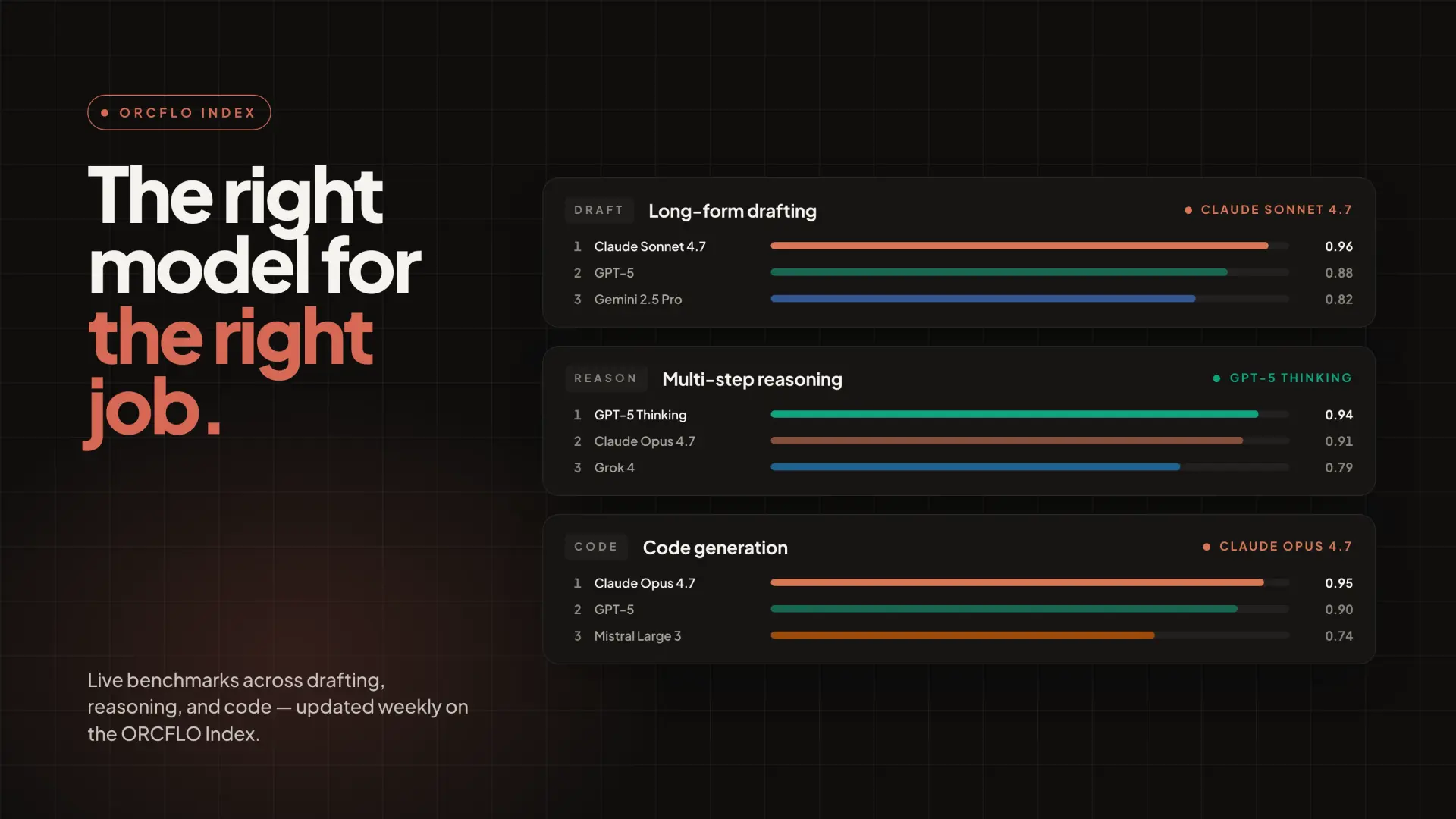
There is no single best AI model. There is only the best model for the task you are doing, subject to the constraints you are operating under. The "use GPT for everything" default is an artifact of how chat interfaces are built, not of how the models actually perform.
The ORCFLO Index is a benchmark of leading AI models on real business tasks: analysis, writing, summarization, structured extraction, instruction-following, stability across runs. It is designed for business users, not researchers. This post is the practical guide: given a task, what does the data say to pick?
What the Index actually measures
Three categories, scored independently:
- Abilities. What the model can do. Analysis, summarization, structured extraction, writing, reasoning under constraints.
- Behaviors. How the model follows instructions and maintains style consistency over a long response. Does the model still respect a "tone: formal" instruction by sentence three, or has it drifted back to its house voice?
- Stability. How reliably the model performs across runs and edge cases. The same prompt run ten times: how much does the output vary?
Forty-plus test cases, multi-judge AI panel scoring, right-or-wrong rubrics. The specific prompts and rubrics are proprietary; the methodology is public.
The point is to answer questions a business user actually asks. Which model writes the best board summary? Which one is most reliable at structured extraction from a 30-page filing, and which one is cheapest for the same quality on a high-volume task?
A practical task-to-model guide
Below is how to think about model selection by task type. The specific Index rankings change as new models release; check the Index for current data.
Analysis (find the insight in messy input)
The task: given a document or dataset, surface the non-obvious insight. A board memo, a competitor's pricing page, a 50-row CSV of customer feedback.
What to look for: high score on the "identifies disqualifying factors" test (does it catch trick questions and false premises), high score on "extracts non-obvious patterns" (does it find the second-order insight, or stop at the surface).
Practical rule: this is where the frontier-class reasoning models earn their token cost. Cheaper models pattern-match on the surface. The cost difference matters less than the insight-quality difference.
Summarization (condense without distortion)
The task: take 30 pages, produce 3. Without losing the load-bearing facts, without inventing new ones, without changing the emphasis.
What to look for: high score on "preserves load-bearing facts," low score on "introduces unsupported claims." Different models bias differently. Some are aggressively concise and drop nuance. Some are over-thorough and bury the point.
Practical rule: for executive-facing summaries, prioritize fact-preservation. For internal scanning, prioritize concision. Different models for different audiences.
Structured extraction (pull data from unstructured input)
The task: read a regulatory filing, output a JSON object with the disclosed liabilities. Read a sales email, output a deal record.
What to look for: high stability score (same input, same output, every time), high score on "respects schema" (does the JSON match the schema you asked for), high score on "abstains when data is missing" (does it return null, or invent a plausible-looking value).
Practical rule: stability matters more than raw capability here. A model that is 95% right with 5% variance beats a model that is 99% right with 20% variance, because the unpredictability of the latter is what hurts downstream automation.
Writing (draft something a human will edit)
The task: write a follow-up email, a LinkedIn post, a section of a blog post. The output gets reviewed by a human before sending.
What to look for: high score on "stays in voice" (does it preserve a tone instruction past sentence three), low score on "AI tells" (does it produce the predictable em-dash-heavy, tricolon-loving prose that announces itself as generated).
Practical rule: different models have different writing voices and bias toward different stylistic defaults. Pick the one whose default voice is closest to what you want. The closer the default, the less time the human reviewer spends rewriting.
Reasoning under constraints (math, logic, multi-step inference)
The task: given inputs A and B and rule R, infer C. Often the substance of compliance checks, eligibility decisions, and "is this a duplicate of an existing record."
What to look for: high score on "follows multi-step rules without skipping," high score on "abstains when input is incomplete," low score on "fabricates confident-sounding wrong answers."
Practical rule: this is where the reasoning-tier models outperform meaningfully. For high-stakes inference, paying for the bigger model is usually right.
The cost-quality tradeoff
The Index reports cost and time alongside quality. A workflow that runs once a week on five inputs should pick on quality alone. A workflow that runs 10,000 times a day on customer messages cannot afford to.
A useful pattern, when a workflow has multiple AI steps:
-
First step (cheap, high-volume routing or classification): pick the cheapest model that hits the quality bar.
-
Middle steps (the actual work): pick the highest-quality model for the specific task.
-
Last step (formatting or final polish): cheap model again.
ORCFLO supports per-step model selection precisely because this is the right design. Tools that force one model per workflow leave both cost and quality on the table.
What model selection looks like in ORCFLO
Each step on the canvas picks its own model. When you click the model picker, you see the ORCFLO Index rankings for the task category. That is the design intent: model selection is evidence-based and per-step, not guesswork.
The Index expands continuously as new models release and as new test cases get identified by customers. If there is a task category you care about that is not covered, that is a useful signal. Write to us.
Three rules to follow
- Stop defaulting to one model for everything. It is the single biggest leak of both cost and quality in production AI workflows.
- Match the model to the task, not the brand. Brand loyalty to a model vendor is a tax you pay for not checking the data.
- Re-check the data with new benchmark results. The frontier moves. The model that was best six months ago may not be today.
Try ORCFLO free. The ORCFLO Index is open to everyone.